Control movement with clear, ordered instructions.
CODEWHIZ · CYTRON LEARNING PATHWAY
ZOOM:BIT
Robot cars & intelligent sensing
Build a robot car that follows instructions, senses its surroundings and responds to a changing track.
Build & program a robotmicro:bit · Microsoft MakeCode
Placement, timetable, fees and kit arrangements are confirmed with CodeWhiz before enrolment.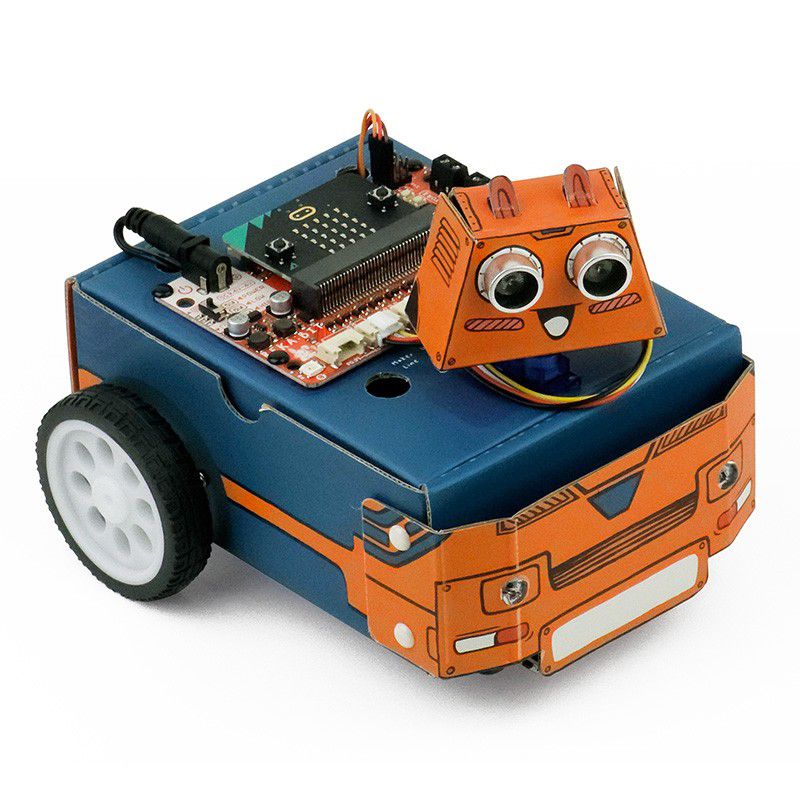
 CodeWhiz Sdn. Bhd.
CodeWhiz educators connect authentic hardware and official learning resources with guided building, coding and testing.
WHAT THEY’LL LEARN
Build confidence through making.
See the link between a program and a moving robot. Learners assemble, code and calibrate their car, then improve its behaviour by observing real test runs.
Use sensor feedback to decide what the robot does next.
Calibrate and debug a robot through repeated testing.
THE LEARNING JOURNEY
From an idea to a working system.
These themes describe the learning direction. The number of lessons, pace and challenge level are adapted to the learner and confirmed before enrolment.
Build & connect
Identify the controller, motors and sensors, assemble the robot and check its connections.
Movement & sequences
Experiment with direction, speed, timing and repeatable movement patterns.
Follow a line
Read the line sensor, tune thresholds and use conditions to keep the car on track.
Sense & respond
Use ultrasonic distance readings to detect obstacles, then test and improve the response.
PROJECT EXAMPLES
Something they can demonstrate.
Project examples show what the tools can support. Teachers choose suitable challenges as students progress.
Robot delivery route
Program a short route with turns, stops and a clear destination.
Line-following challenge
Tune the robot to follow a track and explain why it needs calibration.
Obstacle-aware rover
Use distance feedback to stop or change direction before an obstacle.
Optional AI extension: a HUSKYLENS vision bundle can introduce face, colour, object or tag recognition. It requires additional AI hardware and is separate from the standard robot-car pathway.
FIND THE RIGHT START
Who is this pathway for?
Learners interested in building and coding a moving robot. Beginners can start with guided blocks; prior coding experience supports more independent challenges.
Share previous coding experience, confidence with instructions and project interests. Our team will help match the starting point and teaching format.
A teacher guides the process.
The aim is to understand the project, not only follow a build. Students practise predicting, testing, debugging and explaining their choices.
01Build & connect
02Code & test
03Explain & improve
Course teaching is delivered by CodeWhiz using Cytron hardware and learning references. You can preview the official resources or explore hardware options separately. Shop prices refer to hardware, not course fees.
A few parent questions.
Does my child need to own the kit first?
Please speak to CodeWhiz before purchasing. We will confirm the exact hardware, what the learning package includes and whether an existing kit is suitable.
Is this the same as buying a kit or using free tutorials?
The course adds teacher guidance, project selection, debugging support and feedback. Public Cytron resources remain available; teaching arrangements and course fees are confirmed separately.
How many lessons are there, and what does it cost?
The course page describes learning themes, not a fixed package. Contact CodeWhiz to confirm the starting level, number of sessions, schedule, fees and kit inclusion for your learner.
Curious about ZOOM:BIT?
Tell us a little about your learner. We will help you find the next practical step.